
Gate Access Control in Orlando
Keypads, remotes, intercoms and readers, set up around the people who use the gate.
Access control is the part of an automatic gate that decides who it opens for. A keypad on a gooseneck pedestal, a remote clipped to a car visor, an intercom at the entry, a reader for cards or fobs: in the end each one does the same job, sending an open command to the operator’s control board. What differs is who can use it, how easily that list can change, and what happens when a visitor, a courier or a fire truck pulls up.
We handle keypad and remote programming and intercom or access control hookups for homeowners, landlords with rental properties, property managers with parking or entry gates, and small businesses that secure a yard or lot. The right setup depends less on the device than on the people who use the gate.
Ways In Through an Automatic Gate
Most gates use two or three of these together: a keypad and remotes for the people who live or work there, an intercom for visitors, a loop on the way out.
| Option | How people enter | Best for | Things to plan for |
|---|---|---|---|
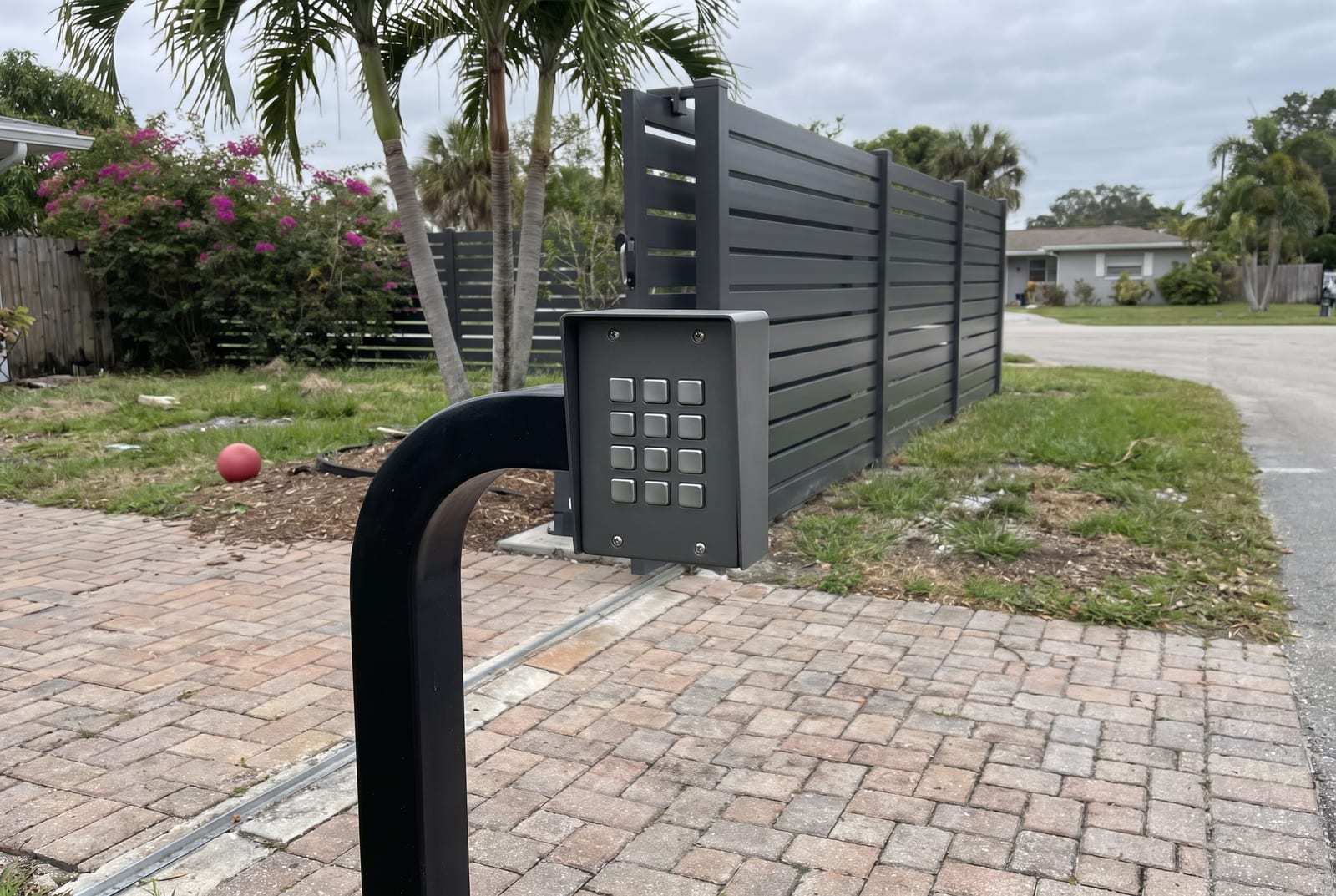
| Keypad | A code entered on a pad, usually on a gooseneck pedestal at the height of a driver’s window | Homes and small properties where a few codes cover everyone | Codes travel. Change them when a tenant, a cleaner or a contractor no longer needs one, and give a pad in full sun a housing rated for it. |
| Remote transmitter | A button in the car sends a radio signal to the receiver wired to the operator | Households with a few regular drivers | Each remote is paired to the receiver. A lost one should be erased from the receiver’s memory, not only replaced, and range depends on where the antenna sits. |
| Intercom | A visitor presses a call button at the entry; someone answers and opens the gate | Homes where guests and deliveries arrive often | It needs a link to the house: a wired run, a wireless unit or a cellular module. Video adds a camera and its own wiring. |
| Card or fob reader | A card or key fob held to a reader opens the gate, and each credential can be switched off on its own | Rentals, parking and entry gates, shared lots with many users | Someone has to keep the user list current. Many systems keep a log of entries, which helps when a question comes up later. |
| Smartphone | An app, or a call from an approved number, tells a controller at the gate to open it | Owners who want to open the gate while away or send a visitor a one-time pass | It depends on a cellular or Wi-Fi signal at the gate. Keep a keypad or remote as a second way in for the day the signal drops. |
| Vehicle detection loop | A wire loop set in a saw cut in the drive senses the metal of a car and signals the operator | The exit side of a busy gate, so drivers leave without a remote | The loop goes into concrete or asphalt, or under pavers before they are laid, and needs a detector at the control board. A second loop can hold the gate open while a car is in its path. |
How a Keypad or Reader Talks to the Gate
Every entry device ends at the control board inside the operator or its control box. A remote speaks to a receiver, which may be built into the board or mounted on its own with a separate antenna. A keypad, intercom or reader is wired to the board’s input terminals, usually with low-voltage cable run in conduit from the pedestal. When the device accepts an entry, it closes a contact, and the board treats that just like the press of a remote.
That is why an older operator can often take a new keypad or reader, and why a new access system sometimes shows up a tired board. The operator still has to open and close safely on every command, with its photo eyes and edge sensors in place. Where the operator itself is the weak point, the work moves to gate openers and automation.
Placement matters as much as wiring. A pedestal set back from the gate lets a car wait off the street while the gate opens, close enough to the drive that the driver can reach the pad without getting out. Controls a person works by hand belong where nobody can reach through or around the gate to use them. Orlando’s summer lightning is hard on keypads and control boards, so surge protection and a sound ground on the wiring are worth planning in from the start.
Questions to Settle Before Choosing a System
Answering these first usually narrows the choice to one or two setups.
- Who needs entry. Count the regular users and how often they change. A family with two cars suits remotes; a rental with new tenants every year suits a reader with its own user list.
- How visitors get in. Decide who answers the gate and from where. An intercom that rings a phone lets someone open it from inside the house or from across town.
- How deliveries are handled. Couriers often arrive when nobody is home. A separate delivery code that can be changed on its own keeps the household codes private.
- How emergency responders get through. Fire trucks and ambulances need a way in without waiting for anyone. Where the local fire authority asks for one, the gate carries a Knox key switch, opened with a key the fire department holds, or a siren sensor that opens the gate as an emergency vehicle’s siren comes near.
- What happens in a power cut. A backup battery keeps the gate running for a while; after that, the manual release lets it be moved by hand. Decide whether a gate without power should stay locked or be easy to open.
A Walk Gate Beside the Driveway Gate
An automatic vehicle gate is built for cars, not for people on foot. The safety instructions that come with gate operators say so plainly: pedestrians should use a separate walk gate, kept clear of the vehicle gate’s travel. A matching pedestrian gate beside the drive, with its own lock, is the simple answer.
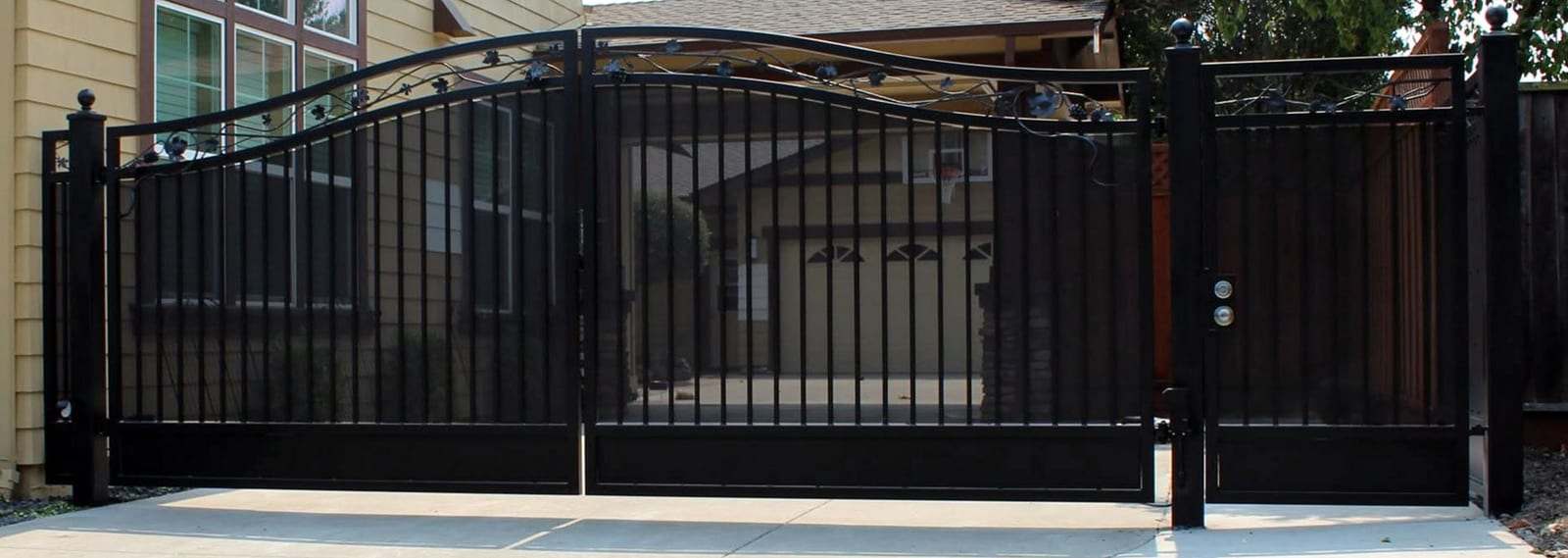
The walk gate can carry access control of its own. A keyed lock suits a household. A keypad or reader with an electric strike or a magnetic lock suits a rental or a shared entry, so tenants come in on foot with the same code or fob they use at the drive. Each electric lock needs power and wiring, so the walk gate and the vehicle gate are worth planning together.
Adding Access Control to a Gate You Already Have
Most access work is added to a gate that already runs. It starts with the existing operator: its control board inputs, the receiver’s frequency and whether the safety devices still work. Then comes the route for the wiring, from the house or an outlet to the pedestal and on to the operator, which may mean a trench across a lawn, a bore under the drive or conduit along a wall.
A few points come up again and again. Remotes from different makers often will not work with the same receiver, so a drawer of mixed old remotes usually means one new receiver and a fresh set. And a code in use for years has usually traveled further than anyone remembers, so a new system is a good moment to start over with new codes. Like any gate job, access work begins with a look at the gate where it stands, the first step of Our Process.
Start With Who Needs to Get In
A keypad, an intercom or a full reader system: call or send a request with the address and a few words on how the gate is used.