
Gate Openers and Automation in Orlando
Swing and slide operators fitted to new gates or replaced on old ones, with the safety devices an automatic gate needs.
An operator turns a gate into a machine that moves on its own, and the gate has to be ready for it. We fit swing and slide operators to new gates and replace operators and motors on existing ones, along with the photo eyes, edge sensors, control boards and receivers that let remotes, keypads and other access control devices run them.
The right operator depends more on the gate than on the name on the cover: the gate type, the length and weight of each leaf, how often it cycles and where the power comes from. Get those wrong, and even a well-made operator wears out early.
Sizing an Operator to the Gate
Gate operators are built and listed for a usage class under UL 325, the safety standard for gate operators in the United States. In plain words, Class I covers a home or a driveway shared by up to four homes. Class II covers commercial and public places, such as an apartment entry, a community gate or a business open to the public. Class III covers light industrial sites with limited public access, such as a loading yard, and Class IV covers restricted sites watched by security staff.
Five things narrow the choice within a class: the gate type, the leaf length, the material, how often the gate runs and the power at the gate.
Opener Sizing Guide
Choose the gate and how it is used for a suggested operator category and the reasons behind it.
Choose the gate and its use, then press the button.
Weight and use matter more than length alone. A long aluminum leaf can weigh less than a short steel one, and a gate that opens a few times a day asks far less of a motor than a shared entry that cycles all evening. Operators rated for more cycles usually run cooler and last longer under steady use.
How Each Operator Moves the Gate
Operators differ in how they push or pull the gate, where they mount and what they ask of the site around them.
| Type | Works with | Good for | Things to consider |
|---|---|---|---|
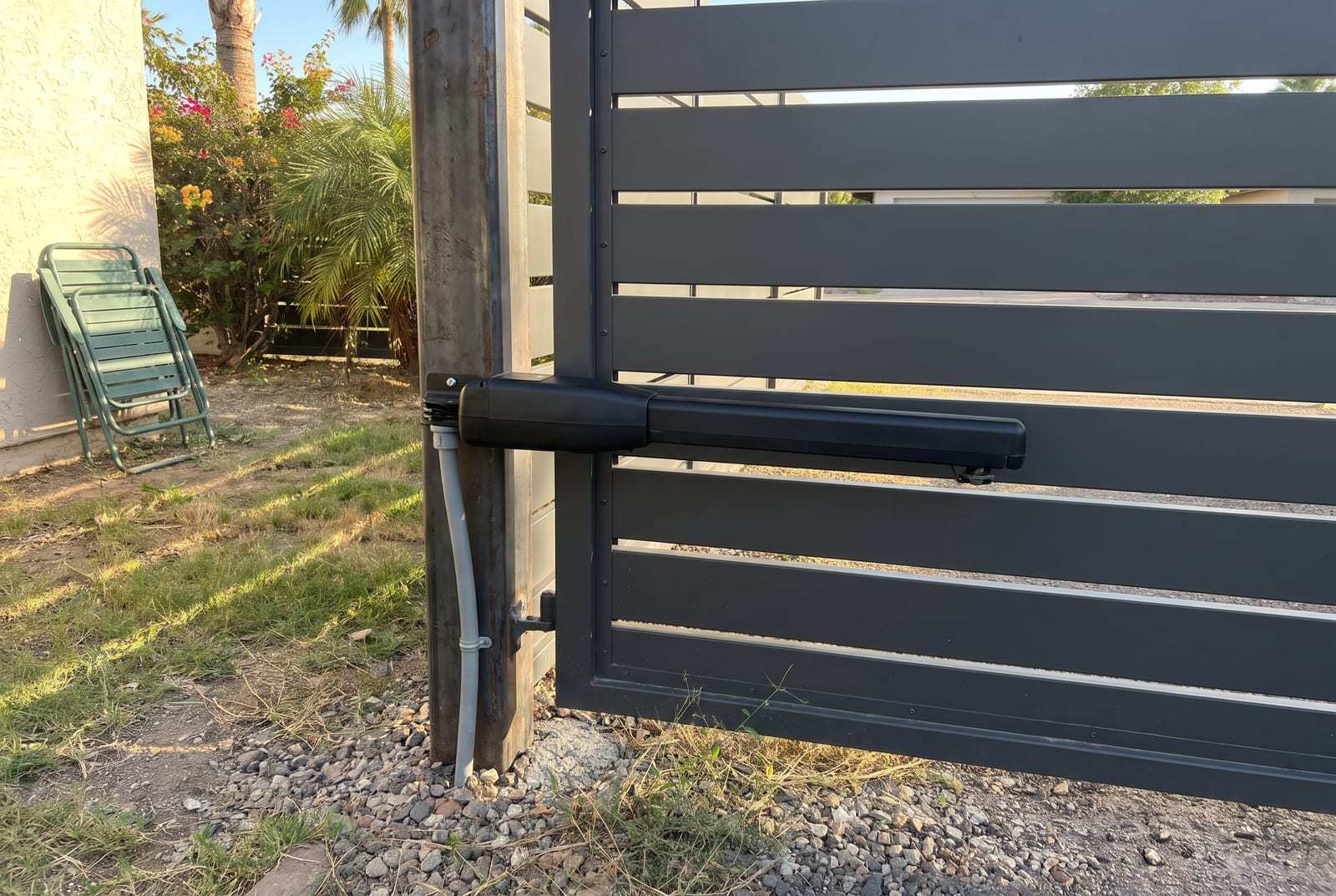
| Linear actuator | Swing gates on slim posts, with room behind the gate for the arm | Light and medium residential leaves | Needs a set distance between the hinge and the post face; a thick pier limits how far it can open the leaf |
| Articulated arm | Swing gates on wide piers, or with hinges set back from the post face | Pier-mounted gates and wide opening angles | The folding arm needs clear space beside it, away from plants, bins and parked cars |
| Underground swing | Swing gates where nothing should show above ground | Ornamental gates at formal entries | The motor sits in a buried housing that has to drain; in a heavy downpour, a box that floods is the usual failure |
| Slide rack-and-pinion | Sliding and cantilever gates | Wide openings, sloped drives and busy entries | Needs a concrete pad beside the opening, and the rack has to stay in mesh with the drive gear as the gate settles |
| Barrier arm | Parking lanes and lot entries | Steady vehicle traffic in and out | Controls cars, not people on foot; usually paired with a loop detector so the arm does not come down on a car |
| Solar DC | Swing or slide gates far from a power supply | Long drives and lots where a trench is not practical | Needs a panel in full sun and a battery sized to the cycles; tree shade and cloudy weeks cut the charge |
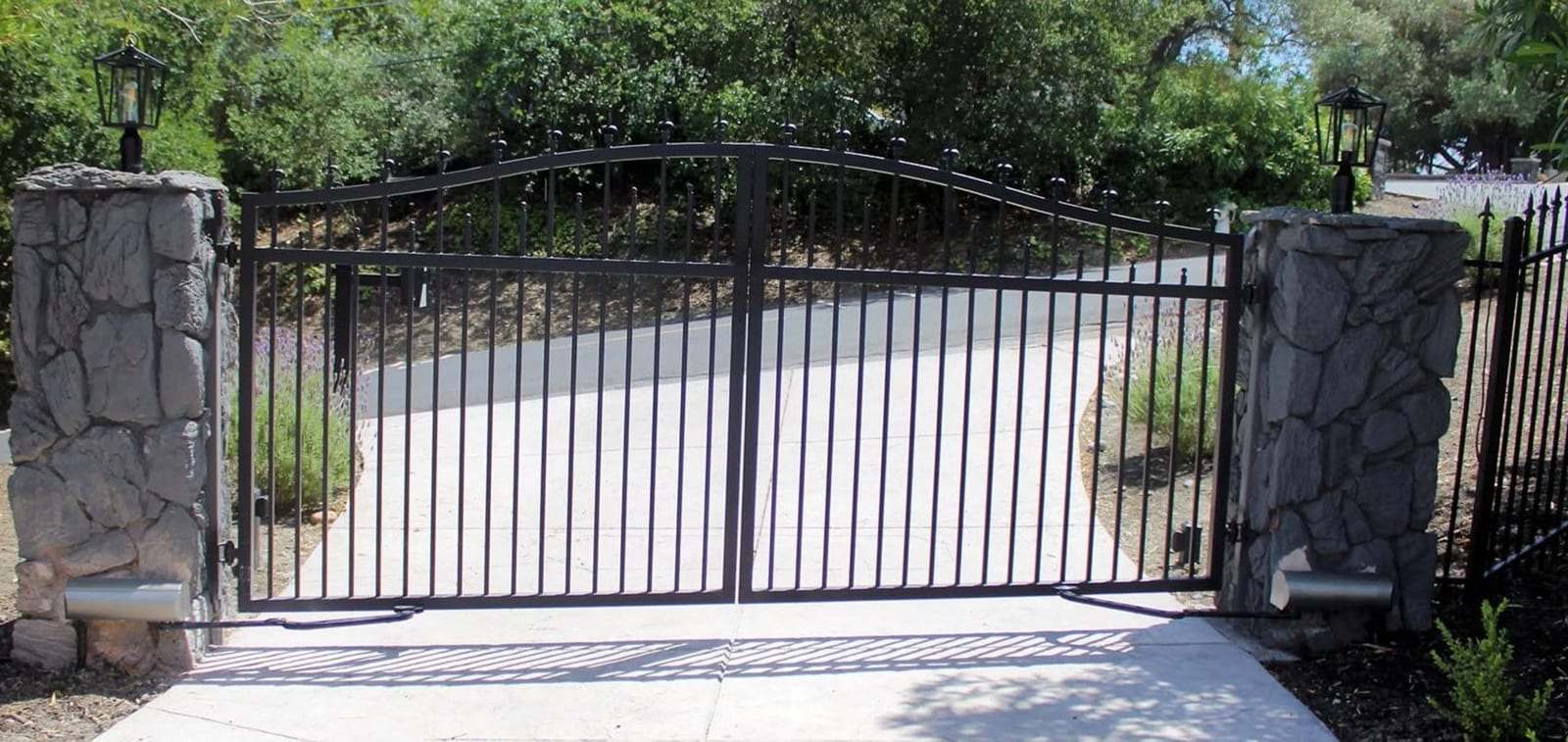
On a double gate hung between stone or stucco piers, the operators usually mount low on the inside face of each pier, where an arm can reach the leaf without needing room behind a slim post. Each leaf gets its own operator, run from one control board so the two leaves open and close together and meet in the middle.
Safety Features an Automatic Gate Should Have
A moving gate is heavy and cannot see anyone. UL 325 asks for entrapment protection on every automatic gate, and a well-set gate has more than one way to stop. Each of these should be in place and working, whether the operator is new or has run for years.
- Entrapment protection. Monitored devices that stop and reverse the gate in each place a person could be caught, opening as well as closing. Operators built to the current standard check that these devices are connected before they run on their own.
- Photo eyes. Beams across the opening and across the swing or slide path, aimed and kept clean, so the gate stops before it reaches a person or a car.
- Edge sensors. Pressure-sensitive edges on the leading edge of a slide gate or the end of a swing leaf, which stop the gate on contact.
- Reversing function. The operator senses resistance and reverses, with the force set no higher than the gate needs to move.
- Manual release. A way to move the gate by hand during a power cut or a fault, which everyone who uses the gate should know how to work.
- A separate walk gate. People on foot use a pedestrian gate, never the vehicle gate.
- Warning signs. Signs on both sides of the gate saying that it moves automatically.
Power, Batteries and Storms
Orlando’s summer storms bring lightning and short power cuts most afternoons. A backup battery keeps a DC operator running through an outage, and surge protection on the power and the loop wiring gives the control board a better chance against a nearby strike. When the battery is flat and the power is still off, the manual release is the way in and out, so it pays to know where it is before it is needed.
Solar operators suit long drives and lots far from a power supply, but they depend on the sun. Shade from fast-growing trees and a run of cloudy, stormy days can leave a busy gate short of charge, so the panel and the battery have to be sized to the use, not just to the gate.
Replacing an Old Operator
An old operator often reaches a point where parts are hard to find or the motor no longer has the strength for the leaf. A newer unit can bring a backup battery, monitored safety inputs and a receiver that works with current remotes. Before a swap, the gate itself needs to move well by hand: a new operator on a sagging leaf or a worn roller wears out early, so gate repair on the hinges or rollers often comes first.
Planning an Automatic Gate
Send the address, the gate type and roughly how wide each leaf is, and we will arrange a time to look at the gate and its power.