
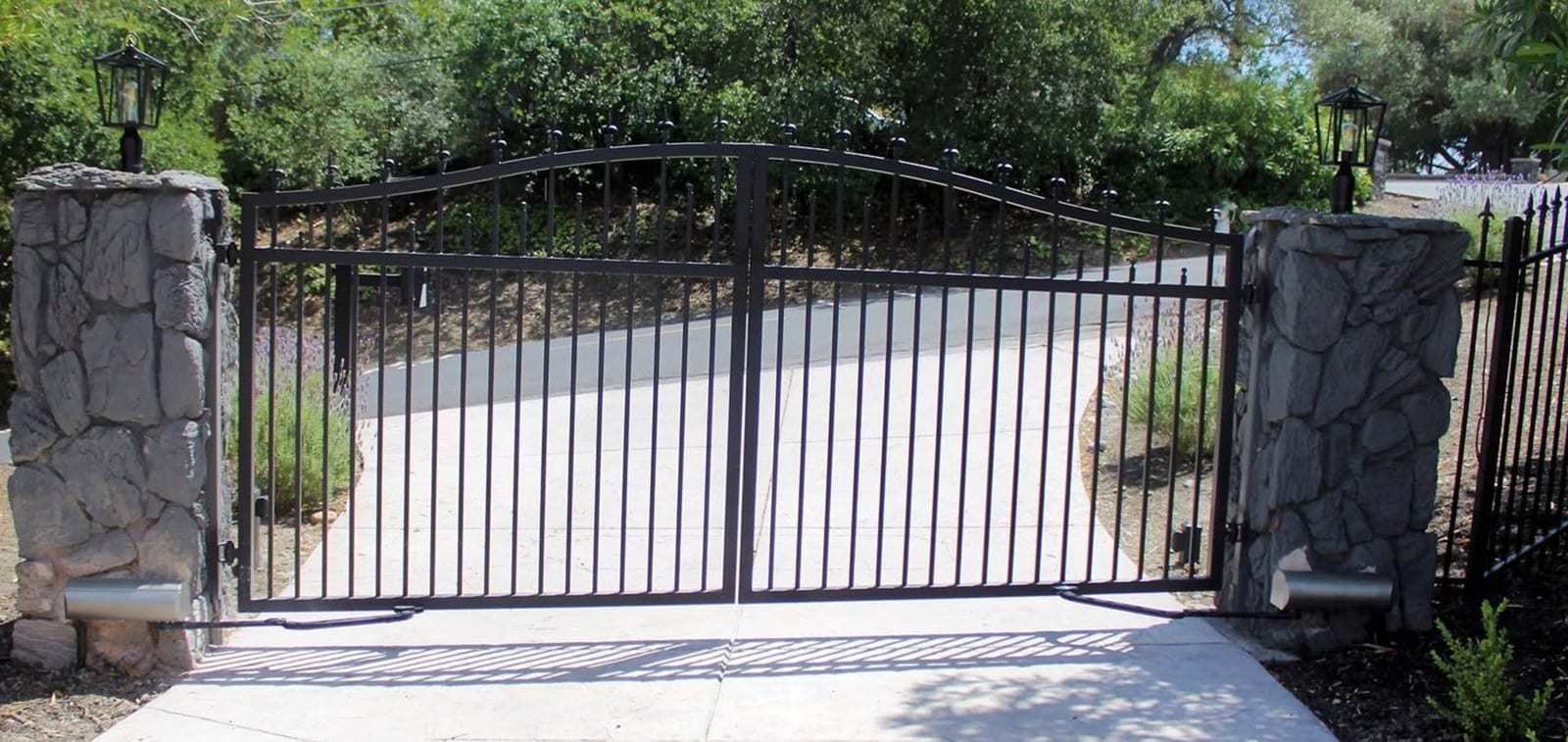
Our Process for Gate Jobs
How a gate job is assessed and carried out, and the rules the work has to meet.
Gate jobs vary widely. One might be a new aluminum swing gate across a home driveway; another a steel slide gate at a parking lot that stops halfway. Under the differences, the work follows the same pattern: look at the whole gate first, plan around what was found, do the work, test it, and hand it back with the owner knowing how it runs.
A gate is a system. The posts and footings, the hinges or rollers, the leaf, the operator, the controls and the safety devices all depend on each other, and a fault in one often shows up in another. That is why the work starts with a look at the gate, not with a part, across all five lines of gate services.
Arranging a Visit
A job starts with a call, or with a message sent through the Schedule an Estimate form. Give the address and a short description of what the gate is doing: that it will not close, that it grinds on the way open, that a remote has stopped working, or what you have in mind for a new gate. From there we arrange a time to come and look at it.
Philip Ramos does the site visits and estimates in person. He walks the gate line, following the gate from one post to the other, and tests the opener through its travel. Then he tells you what needs fixing and what can wait, so you can decide what to do now and what to plan for later.
What Gets Assessed on a Gate Job
A good assessment covers the same handful of points, whether the job is a repair or a new installation.
| Assessment point | What is looked at | Why it matters |
|---|---|---|
| Gate type and size | Swing, slide, cantilever or barrier arm; the length, height, weight and material of each leaf | Weight and length decide the hinges or rollers, the footings and the operator a gate needs |
| Ground and slope | The grade across the opening and through the swing path, drainage, and the soil around the posts | A drive that rises into the swing path limits how far a leaf can open, and loose sandy soil calls for deeper or wider footings |
| Power supply | The distance to an outlet or the panel, the route for a buried line, and sun exposure for a solar setup | A long run changes the wire size and the trenching; a shaded spot leaves a solar panel short of charge |
| Existing hardware | Posts for plumb, hinges, rollers, the operator, its control board and the safety devices | Sound parts can stay in service, while a leaning post or a worn hinge would undo the work around it |
| Traffic and use | How many times a day the gate runs, and whether it serves a household, tenants, staff, trucks or people on foot | Use sets the operator’s duty rating and its UL 325 usage class, and shows where people and cars cross |
| Emergency access | Whether the fire authority or the community requires a responder device, and how the gate opens without power | Fire trucks and ambulances have to get through, and a gate across a shared entrance may need a device the fire authority approves |
Not every point needs a long look. On a repair, the existing hardware and the operator take most of the time. On a new gate, the ground, the slope and the route for power shape most of the design, and in Orlando’s sandy soil the footings deserve particular care.
Typical Stages of a Gate Job
On most gate jobs the work moves through five stages. A repair with the parts at hand may pass through all of them in one visit. A new automatic gate takes longer: the posts are set in concrete that needs time to cure, a permit may have to be issued, and power has to be brought to the operator.
- Assessment. The gate, the ground, the power and the way the gate is used are looked at on site, and the problem or the plan is put in plain words.
- Planning. The parts, the materials and the operator are matched to the gate, and any permit, community approval or utility locate is sorted out before digging or ordering.
- Installation or repair. Posts are set plumb in footings sized for the soil, the leaf is hung or the worn part replaced, and the operator and controls are mounted and wired.
- Testing. The gate is run through full cycles, its limits and force settings are adjusted, and each photo eye, edge sensor and the reversing function is checked by blocking or touching it.
- Handover. The owner is shown how the manual release works, how remotes and codes are added or removed, and what to watch for as the gate settles in.
Safety and Code Rules That Apply to Gates
Automatic gates are heavy machines that move on their own, and several sets of rules apply to them. These come up most often on gate work in Central Florida. The exact requirements always rest with the standard itself and the local authority for the address.
| Rule or standard | Applies to | In plain language |
|---|---|---|
| UL 325 | Gate operators and the safety devices connected to them | The safety standard for gate operators. It sorts gates into four usage classes, from Class I at homes to Class IV at guarded, restricted sites, and requires entrapment protection such as photo eyes and edge sensors. Current operators check that those devices are connected and will not run automatically without them. |
| ASTM F2200 | The construction of automated vehicle gates | How the gate itself is built: no gaps or protrusions where a hand or foot can be caught, screened openings on slide gates, covered rollers, stops at both ends of travel, and a gate that does not move by gravity when its operator is disconnected. |
| Local permit rules | New gates, fences, posts and the electrical work for an operator | Cities and counties around Orlando set their own rules for gate height, setbacks from the road and when a permit is needed, and the electrical work usually needs one of its own. A planned community may add rules on style and color. |
| National Electrical Code, as adopted in Florida | The power supply to an operator, keypad or intercom | Florida’s building code adopts the NEC for electrical work. It covers the circuit that feeds the operator, outdoor-rated boxes, ground-fault protection where required, grounding, and how deep a buried line has to run. |
| Calling 811 before digging (Sunshine 811) | Any digging for posts, footings or a trench for wiring | Florida law asks anyone who digs to contact Sunshine 811 at least two full business days ahead, so buried utility lines are located and marked. Driveway entrances often have water, power and cable lines close by. |
| Fire and emergency access | Gated entrances that fire trucks and ambulances may need to use | The local fire authority may require a way for responders to open the gate without help, such as a Knox key switch or a siren sensor, along with a way to open it in a power failure. |
Safety Points Every Automatic Gate Should Meet
Whatever the gate and whoever installed it, these points are worth checking on any automatic gate you own or manage.
- Photo eyes across the opening at the height the operator’s instructions give, and edge sensors wherever a moving gate could pinch someone against a post or a wall.
- A gate that stops and reverses when it meets an obstruction, and stops when a photo eye’s beam is broken.
- A manual release that works, and an owner who knows how to use it in a power failure.
- Controls placed away from the gate’s moving parts, where nobody can reach through or around the gate to use them.
- Warning signs on both sides of the gate, where people approaching from either direction can see them.
- A separate walk gate for people on foot, so nobody has to pass through the vehicle gate’s path.
- No gaps between the gate and its posts, or along a slide gate’s run, where a hand or foot could be caught.
- A gate that stays put when the operator is disconnected, rather than swinging or rolling on its own.
Start With the Address and What the Gate Is Doing
Call or send a request, and we will arrange a time to look at the gate.