
Gate Repair in Orlando
Hinges, rollers, latches, operators and sensors: the parts that wear, and what each fault usually points to.
Repair work covers driveway swing gates, sliding gates and cantilever gates: hinge and roller repair, operator and motor replacement, keypad and remote programming, and safety sensor adjustment, for homes, rental properties, managed entries and business lots.
A gate rarely fails all at once. It starts to drag, grows louder, stops a few inches short, and a small fault becomes a large one when the operator keeps pushing against it. Caught at the first sign, the fix is usually one worn part rather than several.
Match the Symptom to the Likely Cause
Most faults show up as one of a handful of symptoms, and each symptom has a short list of usual causes. Some are safe to live with for a few days. Others mean the gate should stay off its automatic setting until it is looked at.
Gate Symptom Guide
Pick what the gate is doing to see what usually causes it, and whether to keep using it.
Choose a symptom, then press the button.
Repairs and the Parts Behind Them
Most repairs come down to a small set of parts. Swing gates wear at the hinges and the latch, sliding and cantilever gates at the wheels and the track, and every automatic gate at the operator, the sensors and the settings.
| Repair | Typical sign | Part involved |
|---|---|---|
| Hinge repair or re-hanging | The leaf sags, drags on the drive or no longer meets the latch | Hinge pin, bushing, barrel hinge |
| Roller and track repair | A sliding gate grinds, jumps the track or stalls in one spot | V-track, V-groove wheels, guide rollers |
| Cantilever carriage replacement | The gate rocks, drops at the leading end or binds as it rolls | Cantilever carriages and their rollers |
| Latch and keeper repair | The gate bounces open, or locks only with a push or a lift | Latch, keeper, drop rod |
| Operator or motor replacement | The operator hums, runs slowly or does nothing at all | Motor, gearbox, capacitor, operator arm |
| Control board repair | Erratic movement, a dead display or fault lights after a power surge | Control board, fuses, surge protection |
| Safety sensor adjustment | The gate reverses for no reason or will not close | Photo eyes, edge sensors, loop detector |
| Limit and force setting | The gate stops short of its stop, overruns it or slams at the end of travel | Limit switch, force setting on the control board |
| Remote and keypad programming | Remotes or codes stopped working, or tenants have moved out | Receiver, transmitters, keypad |
Latches, Keepers and the Strike Side
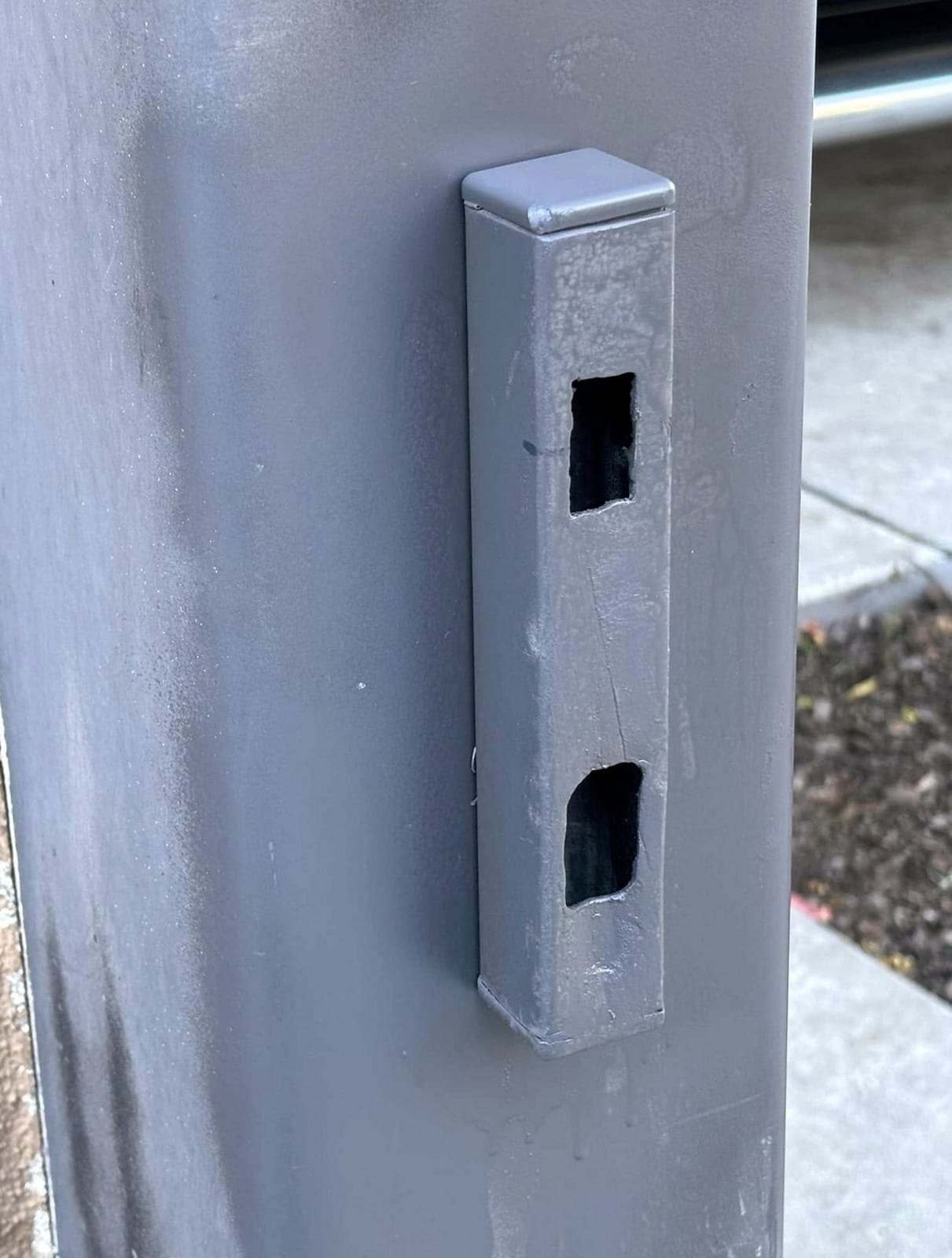
The latch side of a gate takes a knock every time the leaf closes. A keeper welded to the face of the post holds the latch bolt or the drop rod, and as long as the leaf hangs true, the bolt drops into its slot without anyone thinking about it.
When the leaf sags even a little, the bolt starts to strike the edge of the slot instead, and people get used to lifting or shoving the gate to lock it. The cause is often at the hinge rather than the latch: once the leaf is re-hung level, the latch lines up again. A keeper that is bent, cracked at the weld or worn out of shape is usually replaced and set in line with the bolt. On an automatic gate, the lock also has to release before the operator pulls, or the strain lands on the latch and the keeper.
Hinges and Sagging Leaves
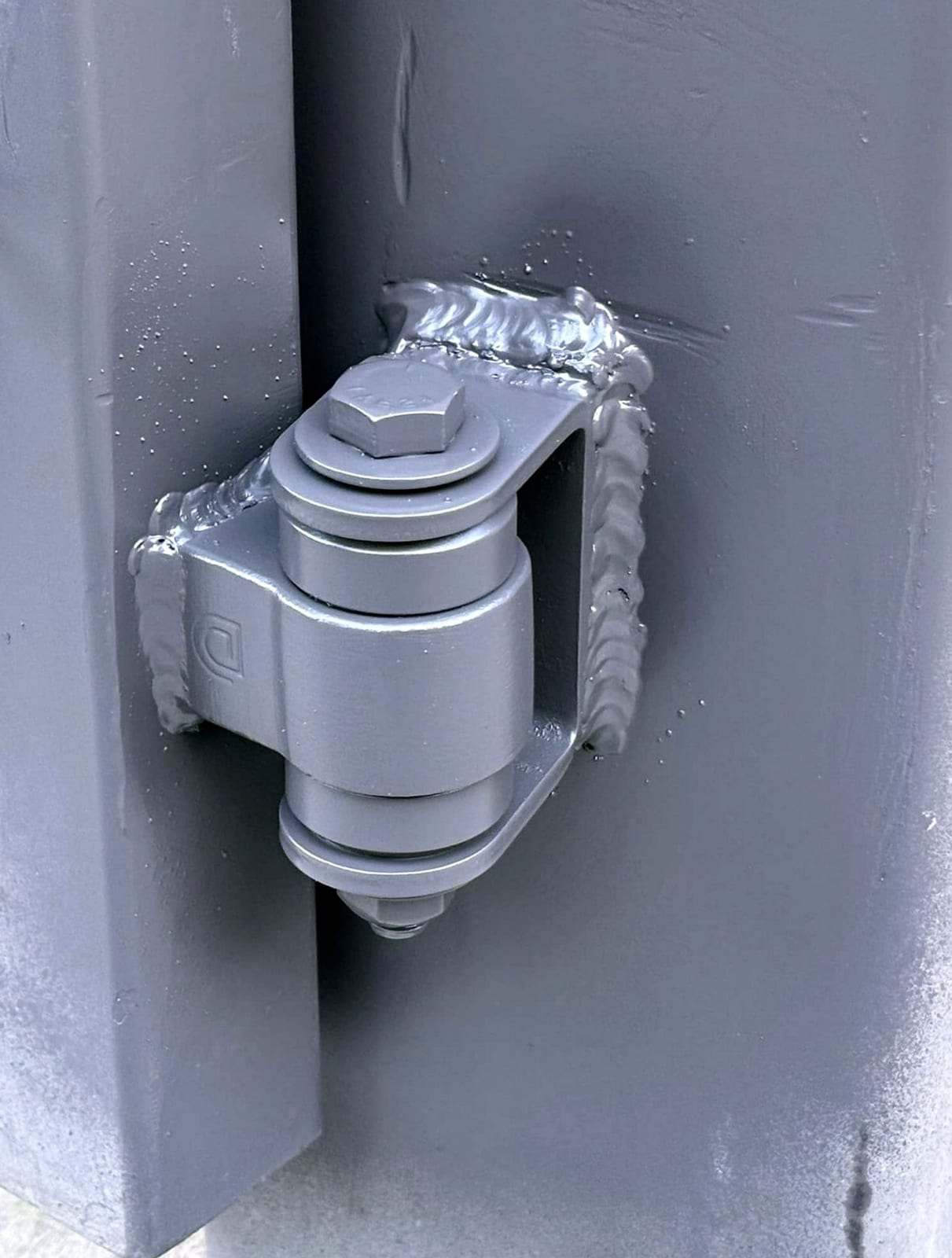
On a swing gate the hinges carry the whole leaf, and the upper hinge takes most of the pull. Heavy barrel hinges with a threaded pin and a nut let the leaf be raised or squared without taking it down, which is why a sag caught early is often an adjustment rather than a new hinge.
Left alone, a sag wears the pin and the bushing oval, drags the bottom rail across the drive and makes the operator work harder on every cycle. Hinges also need grease. A dry hinge squeals first, then grinds, then starts to wear the barrel itself, which is the kind of wear gate maintenance is meant to catch. If the post has moved, no hinge adjustment will hold, and the post has to be straightened or reset first.
Safe Checks Before You Call
A few checks are safe for anyone and sometimes settle the problem on the spot. Leave the control box closed: there is line voltage inside, and the board and the wiring are work for someone with the right tools.
- Power. Check that the breaker feeding the operator is on and that any GFCI outlet it uses has not tripped. Orlando’s summer afternoon storms trip both more often than people expect.
- Manual release. If the gate was moved by hand recently, make sure the release is fully back in its drive position. A release left half-set lets the motor run while the gate stays put.
- Sensor lenses. Wipe the photo eye lenses with a soft cloth and clear anything in the beam, such as a shrub that has grown into it, a trash bin or a parked bike.
- Remote battery. Try a second remote or the keypad. If those work, replace the battery in the remote that does not.
- The path. Look along the gate’s travel for sticks, toys, sand in the track or a leaf rubbing on the drive.
- What it does. Note any beeps or fault lights on the operator, and when the trouble started. Both help narrow the cause.
Repair or Replace
Most gates are worth repairing. Hinges, rollers, sensors, boards and even whole operators are replaceable parts, and a sound frame on plumb posts can outlast several of them. Replacement starts to make more sense when the frame has rusted through at the welds, the posts have moved and taken the leaf with them, or an old operator needs parts that are no longer made. At that point a new gate is often a sounder choice than another round of repairs, and a visit sorts out what needs fixing now and what can wait.
Book a Repair Visit
Call or send the address and what the gate is doing, and we will arrange a time to look at it.